


The sustainability assessment was developed using the methods outlined below, primarily in 2024 and 2025. Initially, existing cross-sectoral and sector-specific approaches to sustainability assessment at the level of companies and value creation systems were identified through literature and desk research. In total, over 70 cross-sectoral sustainability assessment systems were identified in this process. Building on this, a catalogue of criteria was developed which maps existing assessment approaches to the respective sustainability dimensions (environmental, economic, social) whilst also determining whether there is a link to value creation systems or business models within the bioeconomy.
In the next stage, a comprehensive review of the previously identified sustainability assessment approaches was carried out. The focus was on documenting the methods, standards, possible certifications, as well as the criteria and indicators of the respective approaches. Alongside this, a discussion on existing assessment systems took place in the form of expert interviews. A total of seven interviews on sustainability assessment in bioeconomy were conducted, along with a further nine interviews with organisations responsible for existing assessment systems.
The results of the previous work steps were then used to further develop and refine the criteria catalogue The criteria catalogue is structured along ecological, economic, and social dimensions, as well as an overarching sustainability dimension, and comprises (i) links to the SDGs, (ii) specific characteristics of the bioeconomy, (iii) channels of impact on regional structural change, and (iv) technical and organisational aspects of the approaches under consideration. A record of the results, particularly the identified sustainability assessment approaches, was made available on the project website in tabular form for further use by third parties.
The previously developed and refined criteria catalogue was assessed with regard to the suitability and transferability of the individual assessment criteria to the bioeconomy. In this process, the catalogue was structured along the levels of ‘business models’ and ‘value creation systems’ within the bioeconomy. To identify regional requirements for sustainability assessments, interviews were conducted with stakeholders from Bavaria, the Rhine-Neckar region, and Central Germany as exemplary bioeconomy regions. The discussions highlighted, on the one hand, the need for a clear definition of system boundaries. On the other hand, the neglect of economic and social sustainability dimensions, as well as data gaps, were identified as key challenges for regional indicators. Taking these challenges into account, the regional perspective was incorporated into the catalogue as an assessment criterion. The criteria were further refined to enable an assessment of the impacts of bioeconomy business models and value creation systems on regional structural change. This process was further supported by a literature review.
In order to carry out a final overall assessment of the existing evaluation approaches identified, a strengths and weaknesses analysis of 35 evaluation systems was conducted. The assessments were based on the literature review as well as discussions with the organisations responsible for existing evaluation systems.
As a final step before commencing the development of the sustainability assessment, recommendations for such an assessment were drawn up based on all the activities carried out previously. In order to validate the findings already obtained and to identify the region’s needs at an early stage, a further 19 interviews were conducted with experts from the fields of research, business and intermediary organisations in the north-eastern Mecklenburg-Western Pomerania region. The discussions focused primarily on the benefits of sustainability assessment systems for the region, the requirements for such a system, desired applications, the significance of certification, and the expected future importance of sustainability assessment systems.
Based on the results, an initial draft of a sustainability assessment for regional structural change driven by the bioeconomy was drawn up. This involved defining and selecting suitable indicators and relevant data sources, developing checklists and evaluation tools, assessing data availability and measurability, and establishing weighting approaches. In addition, existing assessment systems were analysed and adapted for the regional context, regional mechanisms of impact were delineated, and alignment with the EU Taxonomy, the European Sustainability Reporting Standards (ESRS) and the Corporate Sustainability Reporting Directive (CSRD) was taken into account.
During an exploratory workshop with regional sustainability experts, this draft was discussed and reviewed, and next steps for its further development were derived from this. The workshop was attended by business and industry partners, business development agencies, regional development practitioners and managers of bioeconomy clusters, who provided feedback on the practical applicability and improvement of the sustainability check.
In the subsequent stages, the sustainability checklist was revised several times and assessed in terms of data collection, measurability, and the relevance of the identified criteria and indicators. Indicators were formulated as questions; data sources, availability, and measurability were defined for each individual indicator; measurability was examined from different perspectives (self-assessment/self-check and external assessment by consultants); and weighting was applied (i.e. weighting indicators against each other to address conflicting objectives and to account for regional aspects and business categories). Through this review process and the consolidation of several indicators, the total number of indicators was reduced from over 300 to 175 and, in a subsequent step, to 110. Some indicators are applicable to both business models and value creation systems, whereas others apply exclusively to one of these two levels. This was followed by a categorisation of the indicators according to sustainability criteria as well as overarching categories and sub-categories.
Subsequently, questions for assessing the indicators were formulated, and methods for data collection and evaluation schemes were defined. Due to differences in data collection and evaluation approaches, the sustainability assessment was divided into a business model assessment and a value creation system assessment.
The business model assessment examines a company’s value creation potential in terms of its ability to generate economic returns while simultaneously pursuing environmental and social objectives. The business model module can be accessed and completed via an online questionnaire at https://biooekonomie.uni-greifswald.de/en/projekte/geschaeftsmodellcheck/ . The module serves as a useful complement to the value creation system assessment, enabling the sustainability of individual business models to be assessed and subsequently recontextualised within the value creation system.
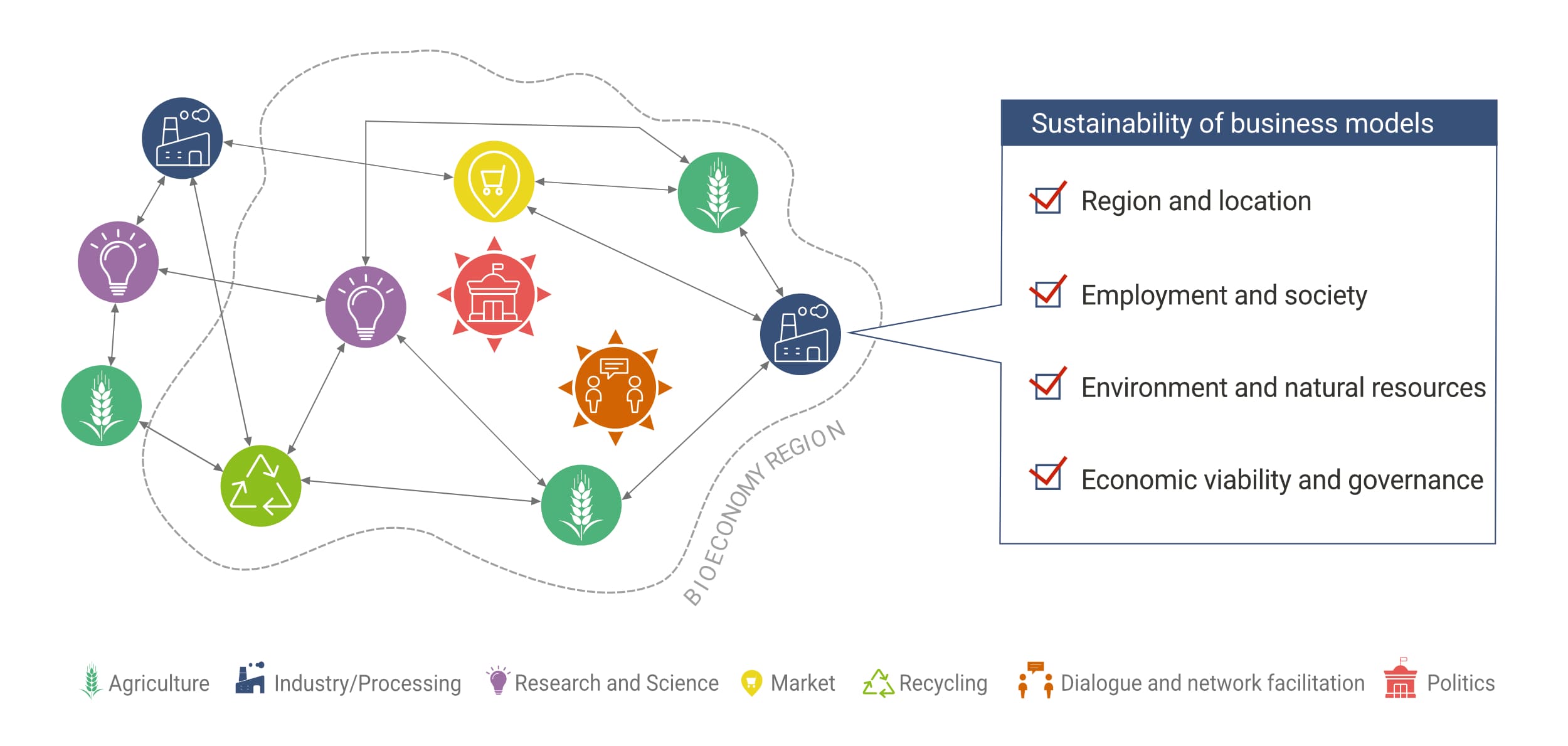
Figure: Sustainability Check for Business Models in Bioeconomy Regions
This guide focuses exclusively on the sustainability assessment for value creation systems. It evaluates the sustainability of entire networks comprising businesses and organisations in dialogue with regional and supra-regional stakeholders from industry, public administration, and research. The aim of this approach is to identify options for action and areas of focus that can support the understanding and advancement of sustainable structural change through regional bioeconomic value creation systems. The prototype for testing the sustainability assessment of value creation systems comprises a selection of indicators from the developed criteria catalogue, which are to be collected through comprehensive data research, surveys, and interviews.
Where necessary, the focus areas identified through the value creation system analysis can be examined from an individual business perspective using the sustainability check for business models. This combination of value creation system and business model perspectives should enable a holistic analysis of the sustainability of processes and structures in bioeconomy regions.
The NaGeWe Bio Sustainability Check for bioeconomy value systems was tested through twelve semi-structured group and individual interviews with bioeconomy experts from industry, public administration, and research between May and August 2025. The interviews aimed to integrate practical knowledge, review indicators across the ecological, economic, social, and governance dimensions, and identify regional transformation pathways for the bioeconomy. During the pilot phase, the prototype of the sustainability assessment for bioeconomic value creation systems was not directly applied; instead, the current state of development was discussed and further refined in dialogue with potential users and stakeholders from the value creation systems. This format was chosen to incorporate as much practical feedback as possible regarding necessary adjustments and opportunities for improving the prototype.
In contrast to business models of individual enterprises, it should also be noted that no single actor or stakeholder can provide a comprehensive overview of a value creation system on their own. A multi-perspective approach based on diverse sources and stakeholders is therefore always required.
The sustainability assessment was tested using the four focus areas of the Plant3Alliance as underlying value creation systems. Consequently, the following value creation systems were examined and discussed during the interviews:
- Building materials
- Food, food supplements and animal feed
- Bioplastics and packaging
- Fine chemicals and phytopharmaceuticals
In this way, the NaGeWe-Bio project fulfils its objective of developing a set of tools with which the alliance’s existing and future strategic directions can be assessed and prioritised according to their relevance for structural change and sustainability. At the same time, the diversity of the approaches considered ensures that the toolkit is broadly transferable to other regions and value creation systems.
The results and recommendations for improvement from the interviews were subsequently synthesised into six thematic clusters using thematic content analysis:
- Strategic Management & Network Governance: Lack of a binding assessment framework for the advisory board and project approval processes (Plant³); need for predictive indicators.
- Regional Value Creation & Resource Management: Insufficient processing of biogenic residues in Mecklenburg-Western Pomerania; need for a primary biomass processing stage to secure regional value creation.
- Criteria for indicators & evaluation logic: Regional identity, resource efficiency, job quality, and innovation capacity; weighting of indicators according to company size.
- One Health / Health Economy: Conceptualisation of the bioeconomy as a contribution to a “health-promoting region”; establishment of linkages between environmental and human health within indicators.
- SME and investor perspective: Lack of practical tools for self-assessment; proposal of a modular structure for the assessment framework.
- Framework conditions & policy: Lack of institutional responsibility; need for a coordinated bioeconomy strategy for Mecklenburg-Western Pomerania across ministries.
During the piloting of the value creation system module, it became evident that the required data collection and survey activities are highly resource-intensive. The necessary data must largely be collected independently, as no existing databases could be identified that meet the required level of spatial resolution and differentiation within value creation systems. While it is, in principle, possible to build the required database through extensive in-house surveys and data collection, the target group for the assessment module often lacks the necessary time and financial resources. To ensure the practical applicability of the assessment tool and to address the needs of the target group, the data collection approach therefore had to be fundamentally revised in light of the pilot phase.
Based on the findings from the pilot testing, the following adaptations were made:
- Development of an indicator framework for cross-cutting topics that are closely related to the sustainability dimensions but cannot be clearly assigned to any of the three dimensions (topics: Regional Structural Change, Governance, and Resilience).
- Integration of an analytical focus and study-specific system boundaries to define the scope of the value creation system (Steps 1 and 2).
- Revision of the data collection process through the development of guidance for designing a questionnaire based on the previously defined study-specific system boundaries, as well as by linking each question to appropriate data collection methods and sources (Step 4).
- Revision of the methodology for analysing and assessing the collected data through the definition of standardized analysis procedures and the development of an assessment scale (Module 3).